Why nearly 90% of enterprise AI projects die before production
Key Takeaways:
- The Pilot Purgatory Problem: Up to 90% of enterprise AI models fail to reach live production.
- Sunk Costs: This failure represents billions of dollars in lost R&D and market opportunity, much higher than the 25-50% failure rate of traditional IT projects.
- The Solution: Shifting from exploratory experimentation to rigorous, scalable capability with aion's audit, 14-day bootcamp, and proprietary Nexus platform
The commercialization of artificial intelligence (AI) has created a profound dichotomy in modern enterprise strategy. Despite unprecedented capital and technical investment, organizations face a staggering reality of systemic failure, with upwards of 80-90% of developed AI models never successfully transitioning into a live environment. Instead, they languish indefinitely in what industry practitioners call “pilot purgatory”.
This widespread failure represents billions in sunk costs, burning at a rate significantly higher than the standard 25-50% failure rate associated with traditional IT projects. Crucially, post-mortems of these failed deployments reveal that the barriers aren’t rooted in fundamental algorithmic deficiencies.
As enterprise AI transitions toward multi-agent, autonomous workflows orchestrating complex business logic, the friction points prevent successful deployment and compound exponentially. This report conducts an exhaustive examination of the structural, technical and strategic failures that define the enterprise AI deployment gap. By analyzing high-profile commercial failures and unpacking the operational architectures of successful organizations, this analysis provides a definitive framework of the true cost of artificial intelligence deployment.

AI Enterprise Failure: What the Studies Show
The widely circulated stat that 90% of enterprise AI models never reach production isn’t exaggerated. It’s the average of extensive evaluations of internal corporate engineering environments, like RAND Corporation's research on AI deployment. RAND found that over 80% of AI models developed in enterprise environments are never deployed. Recent assessments find that at least 50% of generative AI projects are completely abandoned after the proof-of-concept phase due to poor data quality, escalating costs, inadequate risk controls, or an inability to demonstrate clear business value.
The following table aggregates the published failure metrics across the enterprise AI landscape, highlighting the specific modalities of failure:
| Source Authority | Metric | Context and Primary Driver of Failure |
|---|---|---|
| RAND Corporation | >80% | Percentage of AI/ML models built in enterprise or academia that never deploy, driven by misaligned problem-solving and infrastructure deficits. |
| Gartner (Historical) | 85% | Original forecast predicting the percentage of AI projects delivering erroneous outcomes driven by unmanaged algorithmic bias. |
| VentureBeat / Industry Consensus | 87% | Percentage of traditional data science projects failing to reach production, largely due to unstructured data and organizational silos. |
| Gartner (Current) | At least 50% | Generative AI projects actively abandoned post-proof-of-concept due to poor data hygiene, escalating compute costs, and unclear ROI. |
| Gartner (2026 Projection) | 60% | Predicted percentage of enterprise AI projects that will be abandoned through 2026 explicitly due to a lack of AI-ready data management practices. |
| MIT NANDA Report | 95% | Organizations reporting zero ROI despite significant capital investment. |
These stats reveal a systemic failure to translate technological opportunity into concrete economic results. The transition from a controlled environment where a model achieves high accuracy on a static, curated dataset to a chaotic, live environment exposes vulnerabilities that traditional IT management frameworks can’t handle. As the 2026 data indicates, approximately 94% of artificial intelligence projects fail to deliver meaningful enterprise value, driven not by a lack of access to algorithms, but by organizations inability to think about operational transformation.
Why Do Most Enterprise AI Projects Fail?
BCG's research shows roughly 70% of AI failure is people and process-related. Only about 10% involve the AI algorithms themselves. Stanford's 2026 Enterprise AI Playbook analyzing 51 successful deployments found 77% of the hardest challenges were "invisible costs" like change management, data quality politics, and process redesign.
Executive misalignment is the primary culprit. RAND's analysis found 84% of AI failures involve leadership problems: 73% lack clear executive alignment on success metrics, and 56% lose active executive sponsorship within six months. Projects with sustained CEO involvement achieve 68% success rates versus 11% for those that lose sponsorship. The pattern is consistent when AI is treated as an IT project rather than a business transformation.

The talent gap is also structural. There is a massive global demand-supply gap in AI roles, but the scarcest skills are not in model building. They are in MLOps, production engineering, and AI governance. The professionals who can successfully transition a model from a notebook to a live production environment are far rarer than those who can simply build one.
Then there's the trust gap. As AI shifts from passive analytics to autonomous agents that execute real workflows, leaders must handover operational control to probabilistic systems their organizations aren't architected to oversee. A contact center might invest millions building a summarization engine that achieves 90%+ accuracy, only to watch it gather dust because frontline supervisors don't trust it and quietly instruct agents to keep typing manual notes.
What Enterprises Are Successfully Implementing AI?
The most profound differentiator is the recognition that AI is a catalyst for fundamentally redesigning workflows, not just automating legacy processes. Approximately 5-6% of the market successfully bypasses pilot purgatory, achieving transformative, enterprise-wide returns. Companies like Walmart, JPMorgan Chase, and Novartis share a distinct operational blueprint.

Instead of point-solution tools, leaders invest in unified machine learning platforms with built-in ethical safeguards and data lineage tracking. Furthermore, they utilize cross-functional "AI Pod" teams integrating data engineers, MLOps specialists, legal officers, and domain experts from the inception of a project to ensure clear deployment pathways.
- JPMorgan Chase realized $1.5 billion in savings from AI-powered fraud detection and legal document automation. Another product, their “Coach AI system,” increased adviser productivity by 95% and their sales by 20% between 2023 and 2024.
- Walmart optimized its logistics, saving $75 million in a single year by cutting fuel use and improving truck utilization. The company built an ensemble of AI agents to dynamically optimize their "Walmart Fulfillment Engine." They completely redesigned their logistics workflow, saving approximately $75 million in a single fiscal year and eliminating nearly 72 million pounds of CO2 emissions.
- Novartis applied AI to fundamentally redesign clinical trial operations by building a highly regulated, GXP-compliant data platform. This enabled the "Intelligent Decision System" (IDS), a computational digital twin that simulates entire 7-to-9-year trial operational plans before real-world implementation. This integration achieved 72% faster query speeds on massive patient datasets and accelerated the generation of compliance-acceptable clinical trial protocols by up to 87%.
Introducing aion: the Solution to the Enterprise AI Adoption Gap
Knowing why AI projects fail is one thing, having a partner that systematically eliminates each failure is another. aion exists to close the production gap (not with slide decks and strategy reports), but with engineers in the room and systems in production.
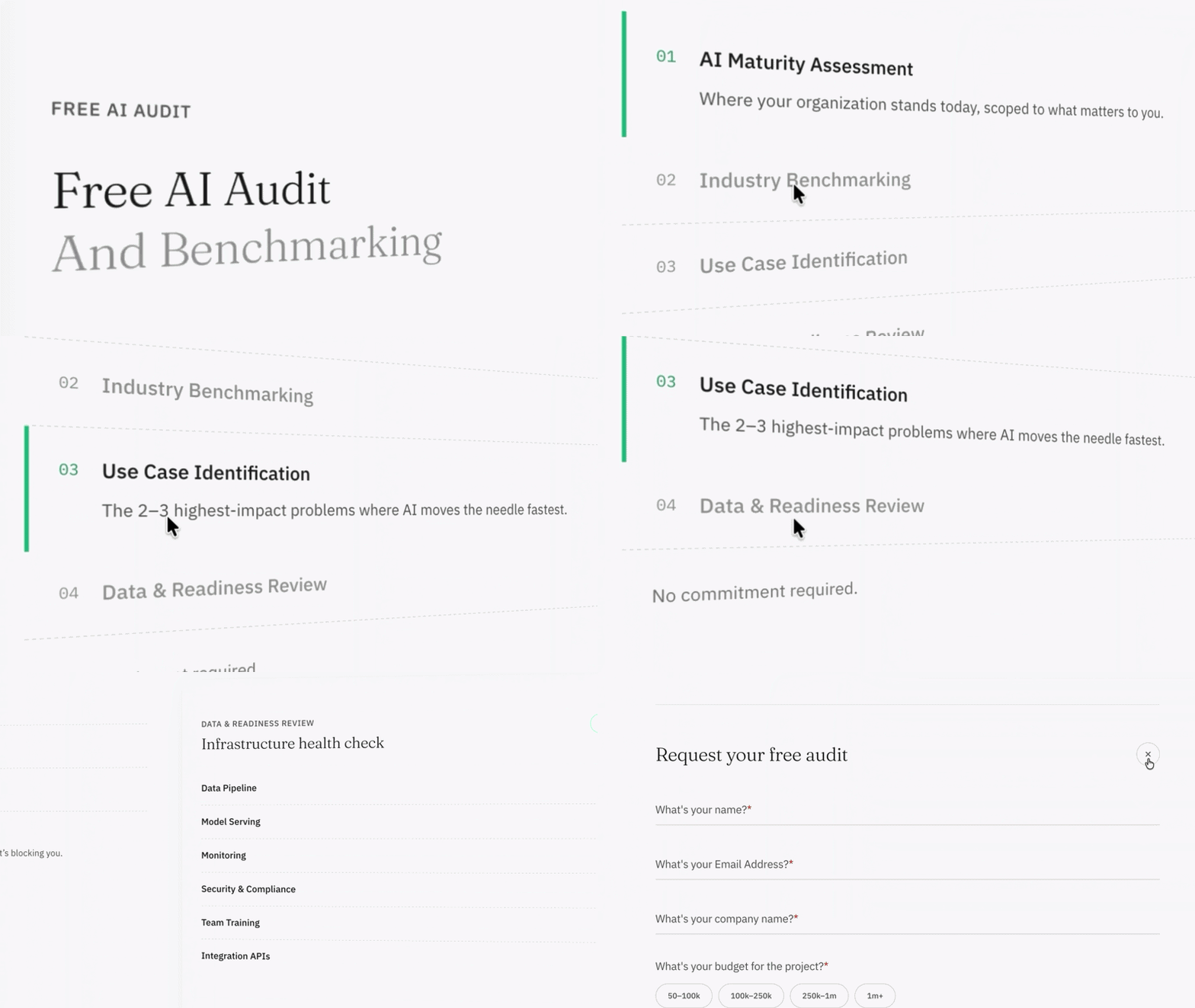
Most enterprises jump straight to building because the pressure to "do something with AI" is immense. aion's AI Audit flips that sequence. In weeks, not quarters, we assess your data readiness, evaluate infrastructure maturity, and pinpoint the high-ROI use cases that actually map to your business pain. The result is an MVP that demonstrates real value fast, not a generic "AI strategy" document that collects dust alongside your stalled pilots.
You don't have 12 months to recruit MLOps engineers and production specialists in a market with a 3.2-to-1 demand-supply gap. aion's forward-deployed engineers embed directly inside your teams from day one simultaneously building production-grade solutions and upskilling your existing people to own and operate them long after the engagement ends. This isn't staff augmentation. It's a structured knowledge transfer so your organization walks away self-sufficient.
In our 14-day bootcamp, aion's forward-deployed engineers and Research team deepdive into your existing systems to tackle data quality head-on. Using our Nexus platform, we build deployments on your data with full governance, so your teams can continuously and confidently operate solutions well after the pilot ends. We promise no vendor lock-in, just production-ready AI on your terms.